





Customizing a WooCommerce email means one of three things, and only the third is both free and codeless. The settings screen changes colours, a logo and three text fields. The PHP template changes anything, at the cost of PHP and a file you then maintain. A customizer plugin gives you an editor instead, and ShopMagic’s free version includes both a visual editor and a Raw HTML action, so a template you already have can be pasted in whole. Below: what the free tiers actually cover, the Raw HTML setup step by step, and the email HTML rules that decide whether your template survives Outlook.
What is free in a WooCommerce email customizer
Three routes to a different-looking email, with very different costs:
| Route | What you can change | Cost |
|---|---|---|
| WooCommerce settings | Logo, four colours, footer text, subject, heading, one paragraph per email | Free, built in |
| PHP template in a child theme | Everything, including layout | Free, but needs PHP and ongoing maintenance |
| Customizer plugin | Content, layout and often entirely new emails | Free tier in several plugins, paid for advanced features |
Among plugins, the free tiers differ in what kind of editing they give you:
| Plugin | Editing style | Free version covers |
|---|---|---|
| ShopMagic | Visual editor and Raw HTML | Unlimited templates, custom emails, filters, test sends |
| Kadence WooCommerce Email Designer | Visual, through the Customizer | Restyling the existing WooCommerce emails |
| YayMail | Drag and drop | Editing the default emails; add-ons for other plugins are paid |
| Email Customizer for WooCommerce | Visual | Editing the default emails |
Free tiers change, so check each plugin’s current page before deciding on that basis.
The distinction that matters for most people is narrower than the feature lists suggest. Most customizers restyle the emails WooCommerce already sends. A customizer built on an automation engine also lets you create emails WooCommerce does not have, which is a different job and the reason the two kinds of plugin are often compared unfairly.
ShopMagic free - WooCommerce email template customizer
Looking for a WooCommerce email template customizer? Look no longer. ShopMagic is your choice if you want to create WooCommerce email templates - including Raw HTML.
Download for free or Go to WordPress.orgTable of contents
- What is free in a WooCommerce email customizer
- Default email templates in WooCommerce
- The free graphical and HTML editor
- Free version versus PRO
- Creating a custom HTML email template
- Writing HTML that survives email clients
- Summary
- Frequently asked questions
Default email templates in WooCommerce
WooCommerce ships with a set of order notifications and very little room to change how they read.
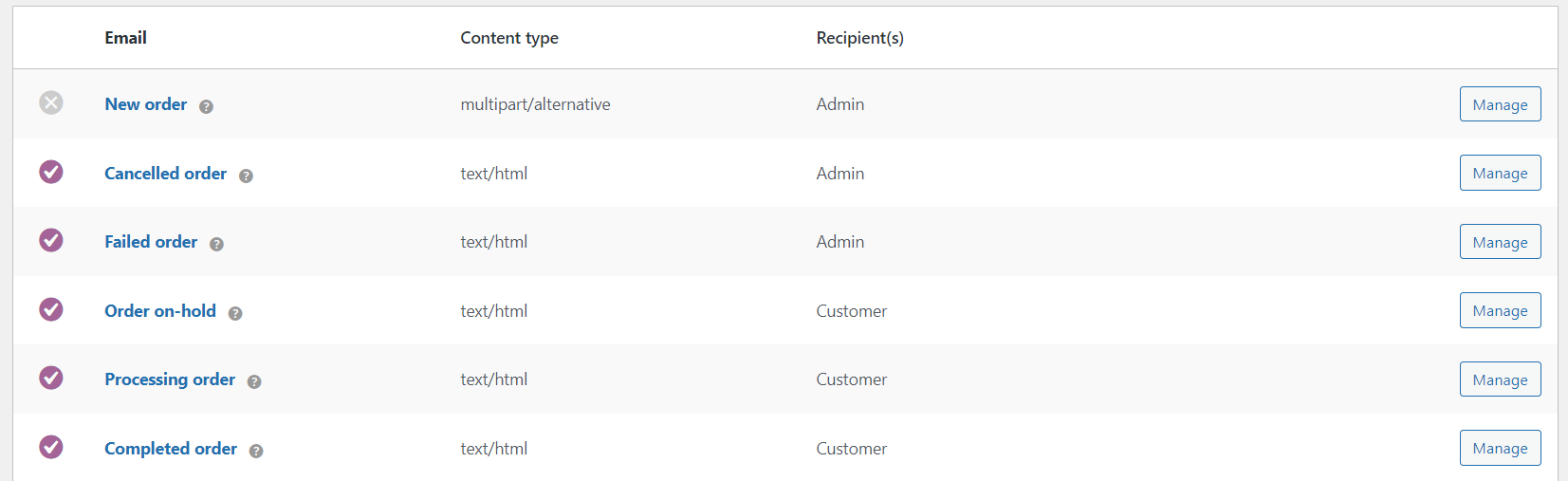
The templates are editable, but editing them means PHP, and a copy in your child theme that has to be reconciled whenever WooCommerce changes the original.
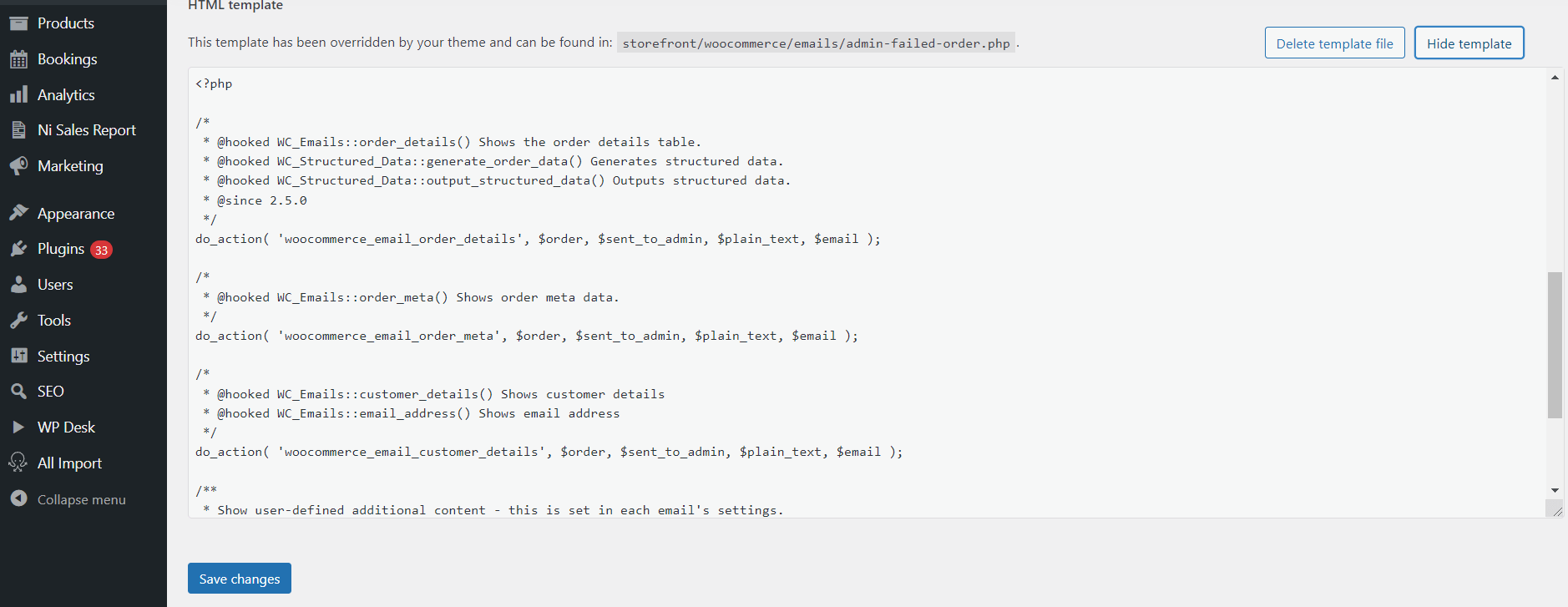
There is a second limit that styling cannot solve: the emails are tied to order statuses. However the template looks, it only goes out when an order changes state.
WordPress itself is stricter still. Its own notifications have no template override at all, so changing them means touching core files, which updates overwrite.
The free graphical and HTML editor
The free version is enough to build and use custom templates, visually or in raw HTML.
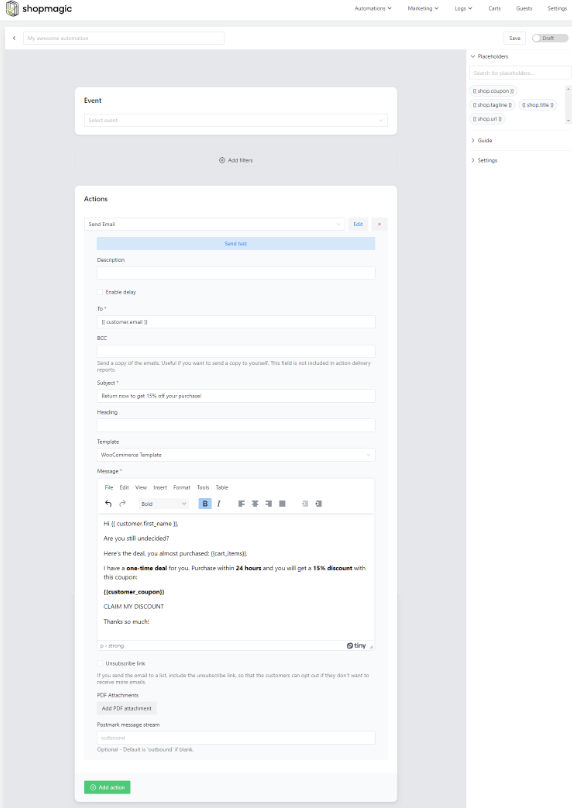
Already have a template? Paste it in.
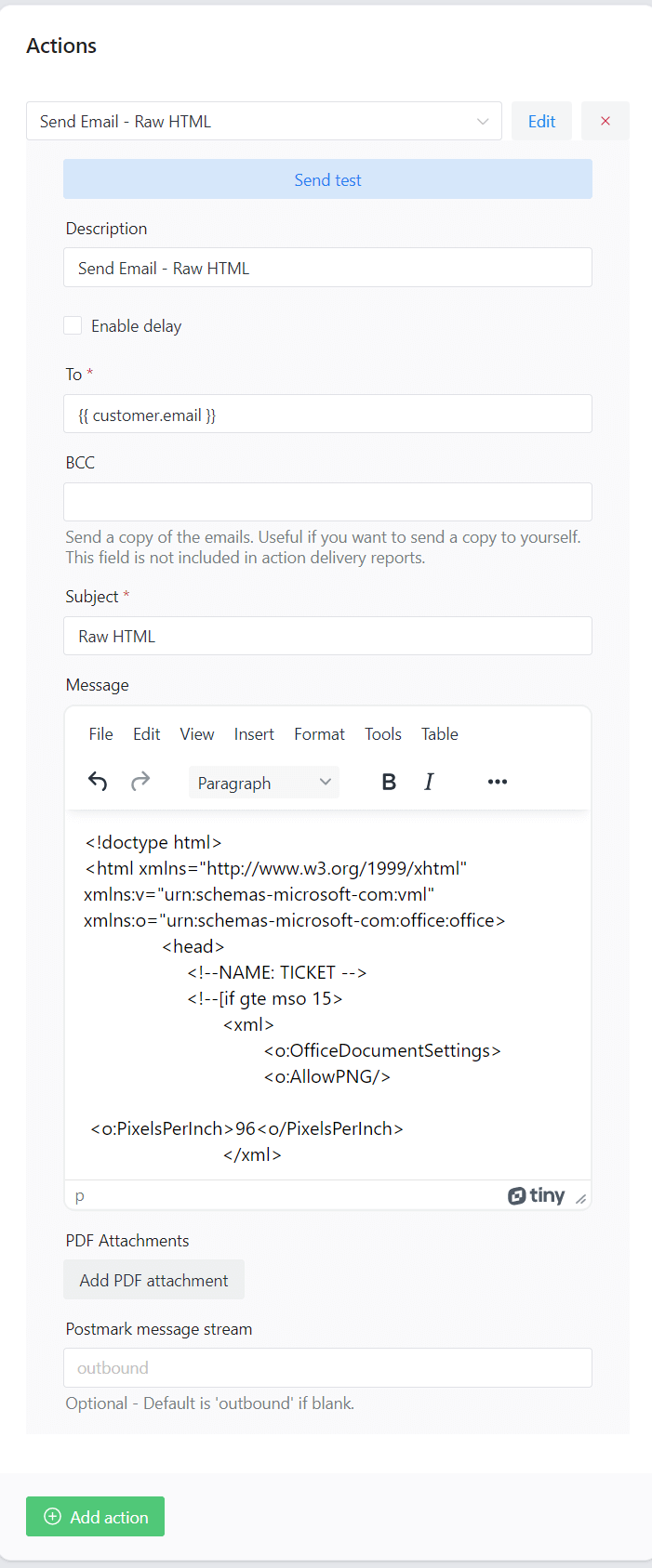
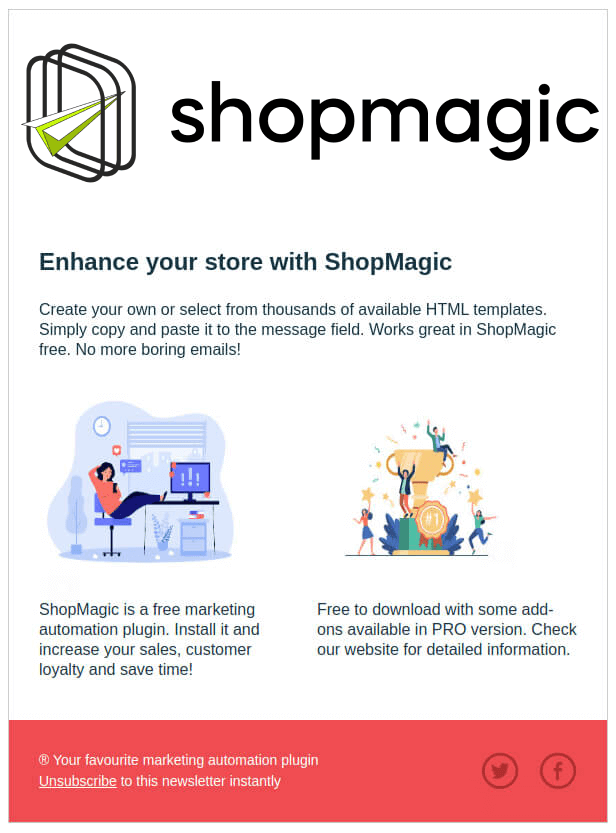
The result:
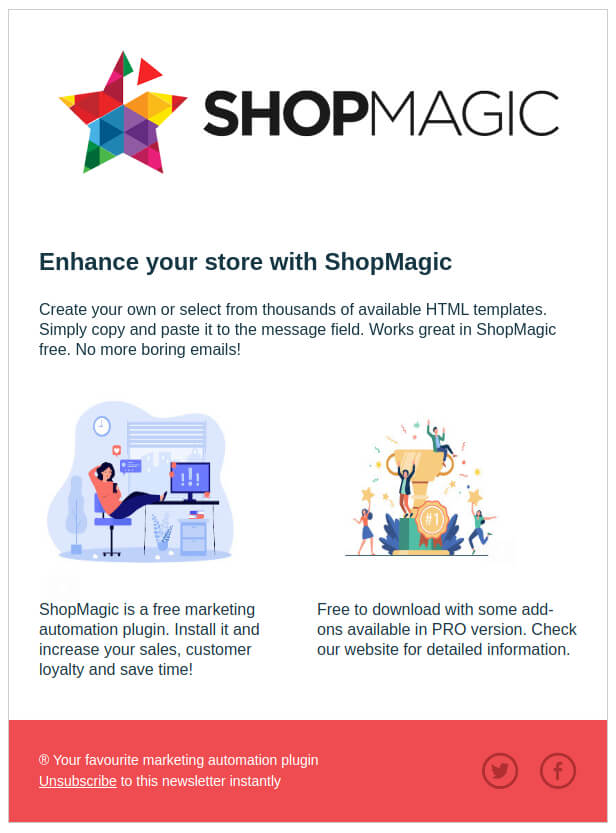
Nothing in the example below needs PRO.
Free version versus PRO
In the free version:
- Customizable transactional emails
- Emails for orders with the pending status
- Test sends before anything goes to a customer
- Marketing lists with consent handling
- Customer segmentation with the built-in filters
- Custom emails in WordPress as well as WooCommerce
- Unlimited templates and automations
In PRO:
- Delaying an email by a set time
- Advanced segmentation
- Manually triggered sends
- Review requests
- Customer coupons
The dividing line is time rather than appearance. Everything to do with how an email looks is free; what you pay for is when it is sent and to whom.
ShopMagic free - WooCommerce email template customizer
Looking for a WooCommerce email template customizer? Look no longer. ShopMagic is your choice if you want to create WooCommerce email templates - including Raw HTML.
Download for free or Go to WordPress.org
Creating a custom HTML email template
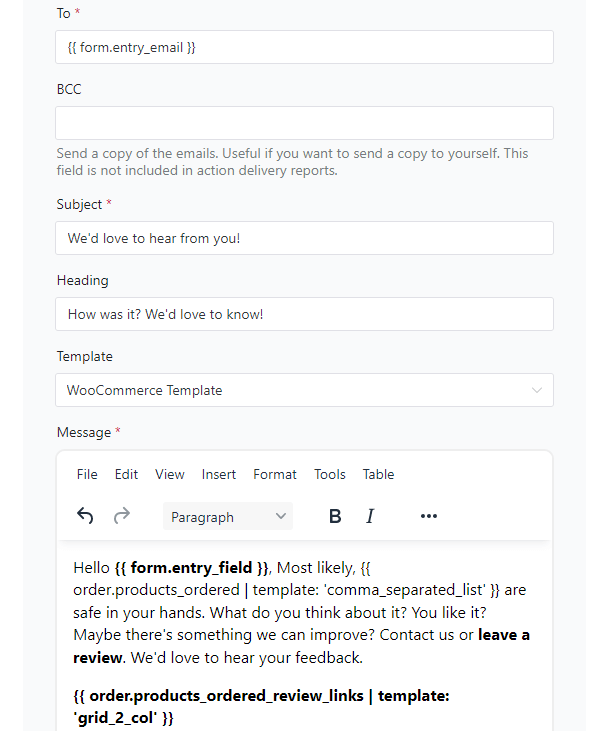
The steps below use raw HTML. The visual editor works the same way if you would rather not touch code.
Step 1: install the plugin
Install ShopMagic from the Plugins screen or as a zip.
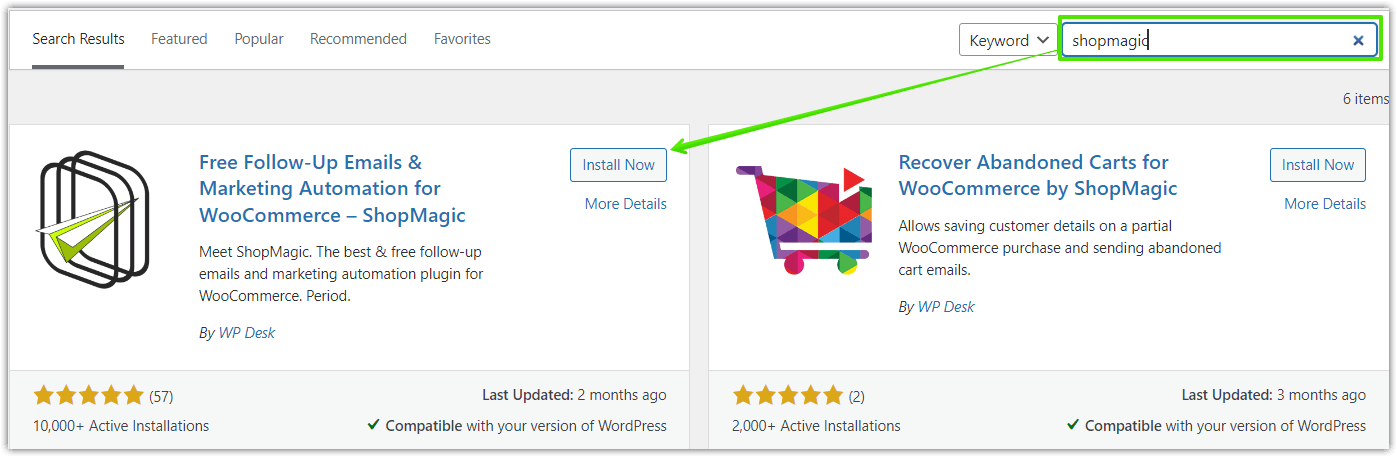
Search for ShopMagic under Plugins → Add New, or download it from the WordPress.org repository.
ShopMagic free - WooCommerce email template customizer
Looking for a WooCommerce email template customizer? Look no longer. ShopMagic is your choice if you want to create WooCommerce email templates - including Raw HTML.
Download for free or Go to WordPress.orgStep 2: create an automation
Go to ShopMagic → Automations → Add New.
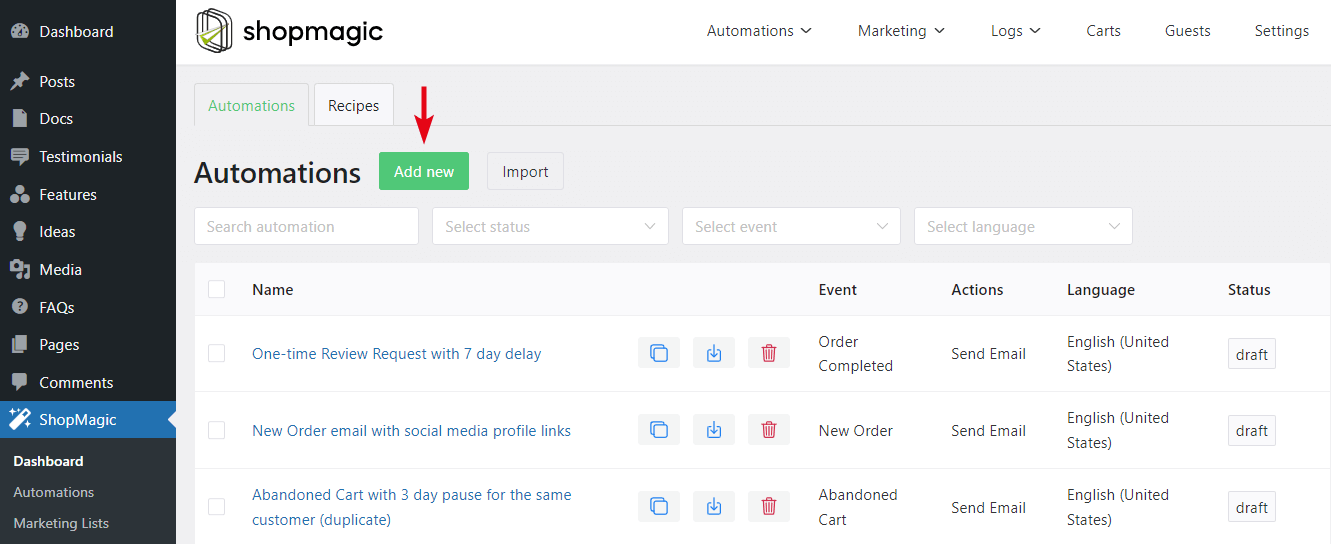
A template lives inside an automation here, rather than replacing a WooCommerce template file. That is why the same template can serve emails WooCommerce does not have.
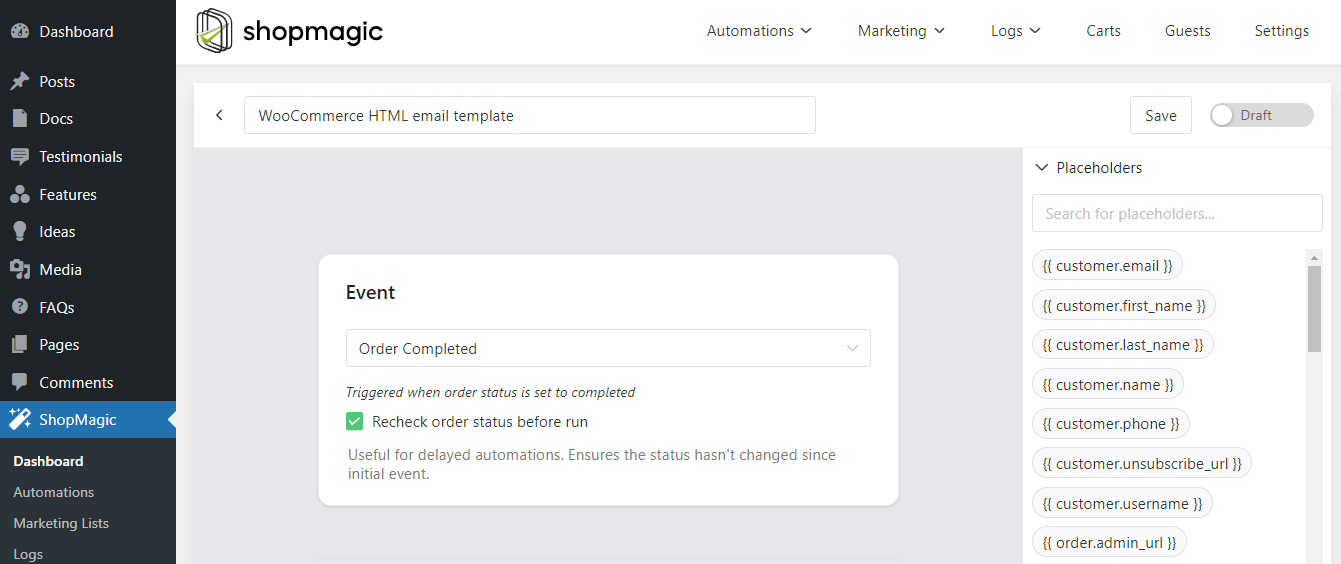
Step 3: name it and choose the event
Give the automation a title, then pick the event that triggers it.

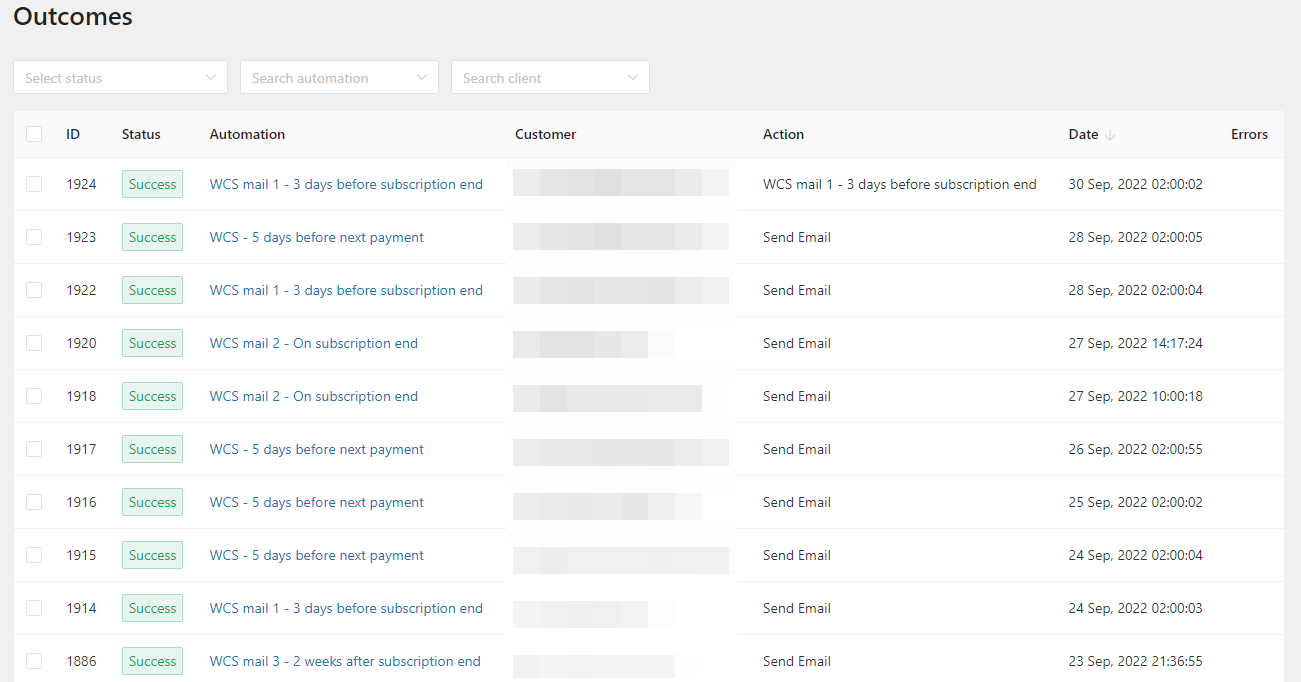
The title is optional and worth writing anyway, because it is what identifies the automation in the logs when you are looking for a send that did not happen.
The HTML template does not depend on the event. Any event will carry it, so pick whichever matches when the email should go out.
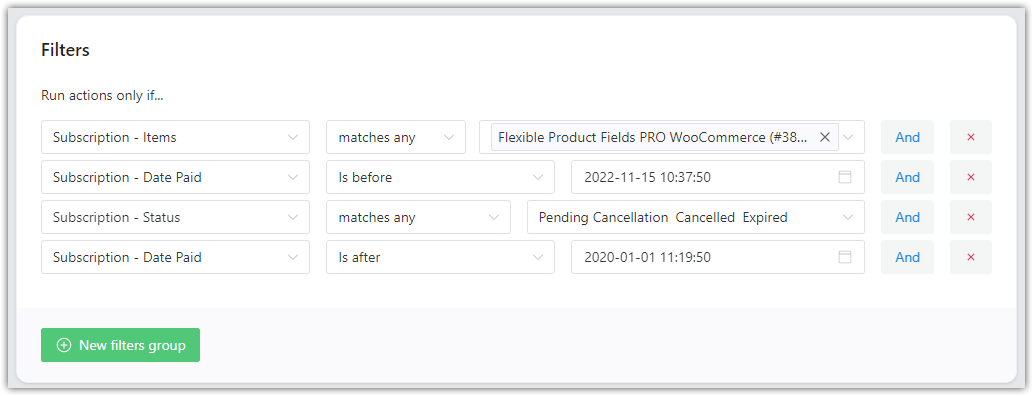
Step 4: add a filter, or do not
Optional, and consequential.
Step 5: add the Raw HTML action
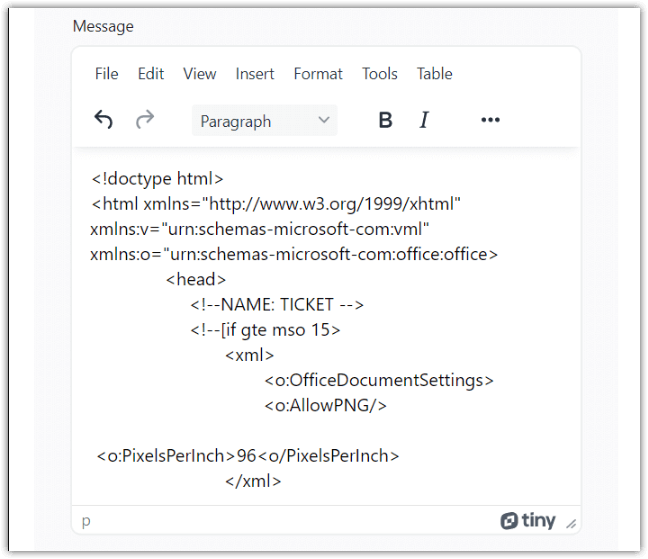
Choose Send Email – Raw HTML as the action. The ordinary Send Email action will not accept a full HTML document; this is the one that does.
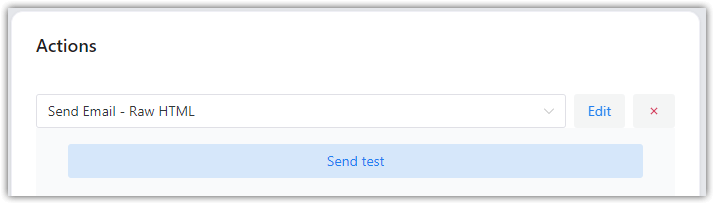
Then fill in the fields.
Description, for your own reference, like the automation title.

BCC, for sending a blind copy to yourself or an internal address. Useful while testing a new template, and worth removing afterwards so your own inbox does not collect a copy of every order email.
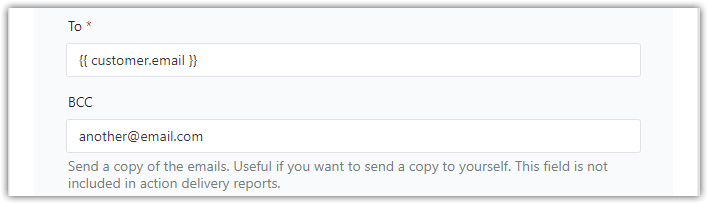
Subject, which supports placeholders, so the order number can go straight into it.

Message, where the HTML goes. Write it here or paste a template you already have.
Step 6: send yourself a test
Use the test send before publishing.
This matters more with raw HTML than with the visual editor, because a template that looks correct in the field can still arrive broken. Placeholders that do not resolve, images that do not load and layouts that collapse all show themselves in an inbox and nowhere else.
Writing HTML that survives email clients
This is where most custom templates fail, and the reason is simple: email HTML is not web HTML. Mail clients render with engines that are years behind browsers, and Outlook on Windows has historically used a word processor’s rendering engine rather than a browser’s. A modern page pasted into the Message field will usually look right in Gmail’s web view and wrong everywhere else.
The rules that matter in practice:
Lay out with tables, not div and flexbox. Nested tables look archaic and are still the only layout method that works everywhere.
Put CSS inline, on the elements. A stylesheet in the head is stripped by several clients, and external stylesheets are not loaded at all.
Use absolute URLs for every image, hosted somewhere public. A relative path has no meaning in an inbox. Assume images are blocked by default and make sure the email still reads with none of them, which is also why alt text earns its place here.
Keep the content width around 600 pixels, the long-standing safe width for desktop clients.
Avoid background images, web fonts, JavaScript and forms. Support is patchy at best, and scripts are stripped outright.
The practical approach is to start from a template built for email rather than converting a web page, then test it. A send to your own Gmail proves very little; the same message in Outlook is the test that counts.
Summary
There are three ways to change how a WooCommerce email looks, and the free options go further than most people expect. The settings screen handles a logo, four colours and three text fields, which covers simple branding. A PHP template in a child theme changes anything, in exchange for PHP and a file you reconcile after WooCommerce updates. A customizer plugin gives you an editor, and in ShopMagic’s free version that includes both a visual editor and a Raw HTML action, with unlimited templates, test sends and filters. What PRO adds is about timing and targeting, delays, manual sends, advanced segmentation, rather than appearance.
The Raw HTML route is six steps: install the plugin, create an automation, name it and pick an event, optionally add a filter, add the Send Email – Raw HTML action, and test. The template is not tied to any particular event, so the same design can carry a confirmation, a follow-up or something WooCommerce has no email for at all.
One caveat decides whether any of this works. Email HTML is not web HTML: tables for layout, inline CSS, absolute image URLs, around 600 pixels wide, and no web fonts or background images. Build from an email template rather than a web page, and test in Outlook rather than only in Gmail, because the difference between the two is where custom templates usually fall apart.
ShopMagic free - WooCommerce email template customizer
Looking for a WooCommerce email template customizer? Look no longer. ShopMagic is your choice if you want to create WooCommerce email templates - including Raw HTML.
Download for free or Go to WordPress.orgQuestions about the setup? Contact us, or leave a feature request on the ideas board.
Frequently asked questions
Is there a free WooCommerce email customizer?
Yes, several. ShopMagic’s free version includes a visual editor and a Raw HTML action with unlimited templates; other plugins such as Kadence WooCommerce Email Designer and YayMail have free tiers focused on restyling the default emails.
Can I customize WooCommerce emails without a plugin?
Partly. The settings screen covers a logo, colours, footer text and per-email subject, heading and one paragraph. Anything beyond that means editing the PHP template.
What is the difference between the visual editor and Raw HTML?
The visual editor builds the message for you. Raw HTML accepts a complete HTML document, which is what you want if you already have a template or a designer produced one.
Does the HTML template depend on the event?
No. Any event can carry it, so the same template works for an order confirmation, a follow-up or an email WooCommerce does not have.
Why does my custom template look broken in Outlook?
Almost always because it was built like a web page. Email clients need table-based layout and inline CSS, and several ignore stylesheets in the head entirely.
Do images work in a custom email template?
Only with absolute URLs to a publicly reachable file, and only when the recipient’s client loads images at all. Write the email so it still makes sense with images blocked.
Can I use a custom template for WordPress emails too?
Yes. The automation can be triggered by WordPress events, so a site with no shop can use the same templates.
What is in PRO that is not in the free version?
Delays, manual sends, advanced segmentation, review requests and customer coupons. Nothing that affects how an email looks.
