





Connecting WooCommerce to Google Sheets takes two free plugins, a Google account and a spreadsheet, and the whole setup is one token pasted into WordPress plus one automation. From then on every new order adds a row with the columns you chose: order ID, date, total, customer details, shipping method, products, a link back to the order. There is no cap on how much you send and no per-operation pricing. Below: the full list of fields you can map, the setup step by step, and the three things that quietly break an export once it is running.
What you can send, and what you need
Four things have to be in place, and none of them cost anything:
- A Google account
- A spreadsheet to receive the data
- The ShopMagic core plugin
- The ShopMagic for Google Sheets add-on
Each column in the spreadsheet is filled by a placeholder that resolves when the order is placed:
| Column | Placeholder |
|---|---|
| Order ID | {{ order.id }} |
| Date | {{ order.date_created }} |
| Total | {{ order.total }} |
| Customer email | {{ customer.email }} |
| Customer name | {{ customer.name }} |
| Customer phone | {{ customer.phone }} |
| City | {{ order.shipping_city }} |
| Shipping method | {{ order.shipping_method }} |
| Products ordered | {{ order.products_ordered }} |
| Link to the order in admin | {{ order.admin_url }} |
The full placeholder list covers considerably more, and orders are not the only source. The same mechanism exports blog post URLs, comments and product reviews, user data, Contact Form 7 and Gravity Forms entries, and data from subscriptions, memberships and bookings, triggered by any available event or fired manually.
Most stores never get their data out at all. WP Desk telemetry from 19,803 WooCommerce stores, collected in August 2026, shows 18.1% with active REST API keys, which is the usual programmatic route. For the other four fifths, a spreadsheet that fills itself is the difference between having order data and looking at it.
ShopMagic
Customize emails, run email marketing, and connect WordPress and WooCommerce with Google Sheets.
Download for free or Go to WordPress.orgTable of contents
- What you can send and what you need
- Why connect WooCommerce to Google Sheets
- Google Sheets for eCommerce analysis
- Google Sheets vs WooCommerce analytics
- Checklist before you start
- Export WooCommerce orders step by step
- Set up the automation
- When the export stops working
- Summary
- Frequently asked questions
WooCommerce to Google Sheets: the benefits
Order data in a spreadsheet is data you can sort, filter, pivot and chart without asking anyone for a report.
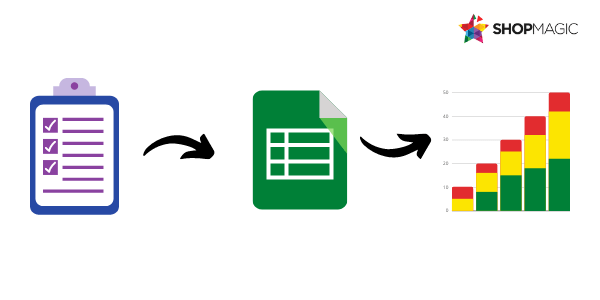
What people actually use it for
- customer segmentation and insights
- product sales analytics
- inventory management
- accounting handovers
- sales forecasting
- feeding data into other apps
- keeping a list of blog subscribers
- logging published posts with custom data
Why the pricing model matters
Most tools that move data between systems charge by the number of operations per month. Pass the threshold and the invoice multiplies, which means the pricing scales with your success rather than with the value you get.
Google Sheets as an eCommerce analysis tool
Google Sheets is free and covers what most stores need to make decisions from their own numbers. It is not Power BI or Tableau, but it handles both routine reporting and things like RFM analysis and segmentation.
Why move WooCommerce data there:
- No interface restrictions: sort, filter and rearrange freely.
- Built-in charts.
- Functions for the calculations WooCommerce will not do.
- Shareable with a link, including with an accountant who has no WordPress login.
- Well documented, with active communities when the documentation runs out.
- Export in several file formats.
- Connects to Looker Studio, formerly Data Studio, if you later want a dashboard.
- Extensible with add-ons and scripts.
- Ready-made integrations in the Google Workspace Marketplace.
The fourth point is the one that decides it for most stores. Giving someone a WordPress admin account so they can read sales figures is a worse idea than sharing a sheet.
Google Sheets vs WooCommerce analytics
WooCommerce analytics is in the same position as WooCommerce emails: present, working, and enough until you need something specific.
Where it runs out
- Limited filtering.
- You cannot reorder columns or rows.
- Built for viewing, not for calculating or modifying.
- No custom reports.
- Manual export only, and only to CSV.
- Reading it requires a WordPress login with the right role.
The two tools are complements rather than alternatives. Analytics answers “how are we doing” at a glance; a spreadsheet answers the question nobody anticipated when the report was designed.
Connecting WooCommerce with Google Sheets
What you will need
- A Google account, for Sheets itself.
- A spreadsheet to receive the data. Create it before you start; pausing mid-setup to make one is where people lose their place.
- The ShopMagic core plugin, which provides the automation interface. Download it or install it from your dashboard.
- The ShopMagic for Google Sheets add-on, which handles the connection. Also in the WordPress repository.
The same method works for WordPress without WooCommerce, for saving posts, users or subscriber data. The steps below use orders because that is the common case.
Export WooCommerce orders to Google Sheets
Step 1: create the spreadsheet
Make a new sheet and name its columns.
Open Google Sheets and create a blank spreadsheet.
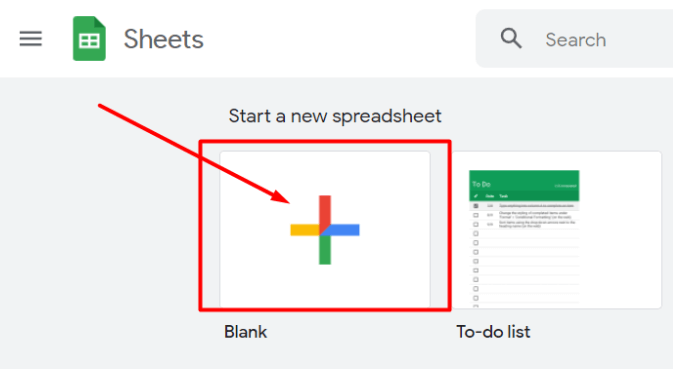
A workable starting set of columns: Order ID, Date, Total, Customer email, Customer name, Customer phone, City, Shipping method, Products ordered, See order link.
Put them in the first row and decide now, because changing the structure later is the most common way to break the export.
Step 2: install both plugins
Install the ShopMagic core plugin and the Google Sheets add-on.
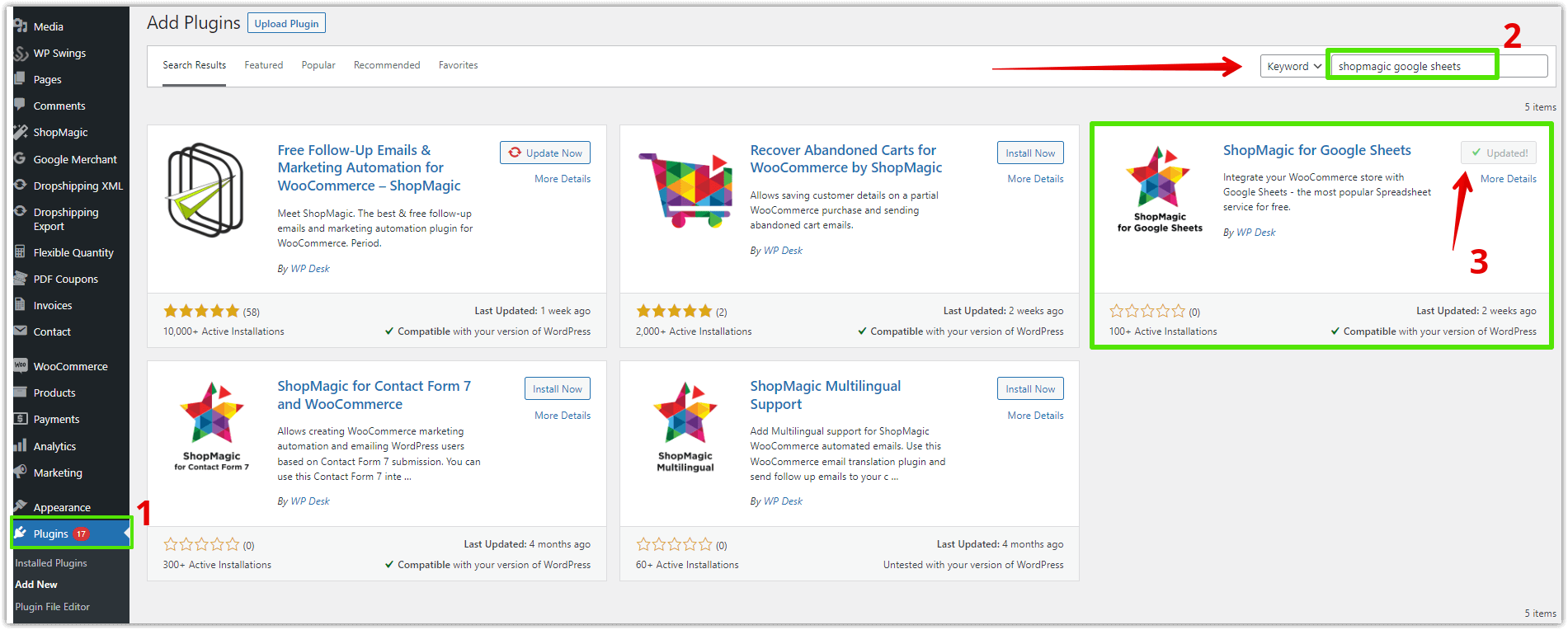
Step 3: authorise the connection
Get a token from Google and paste it into ShopMagic. Seven actions, one of them a copy and paste.
1. Open the Google Sheets settings
Go to ShopMagic → Settings → Google Sheets and find the empty Google Sheets Token field. Click Get Google Sheets token.
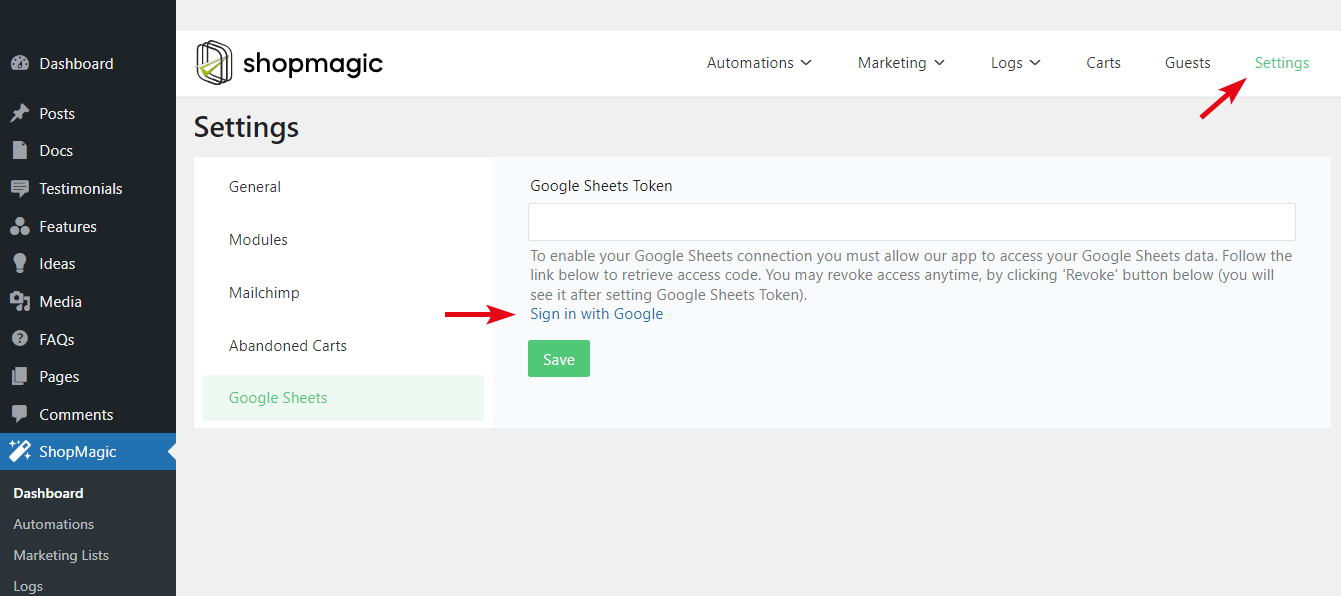
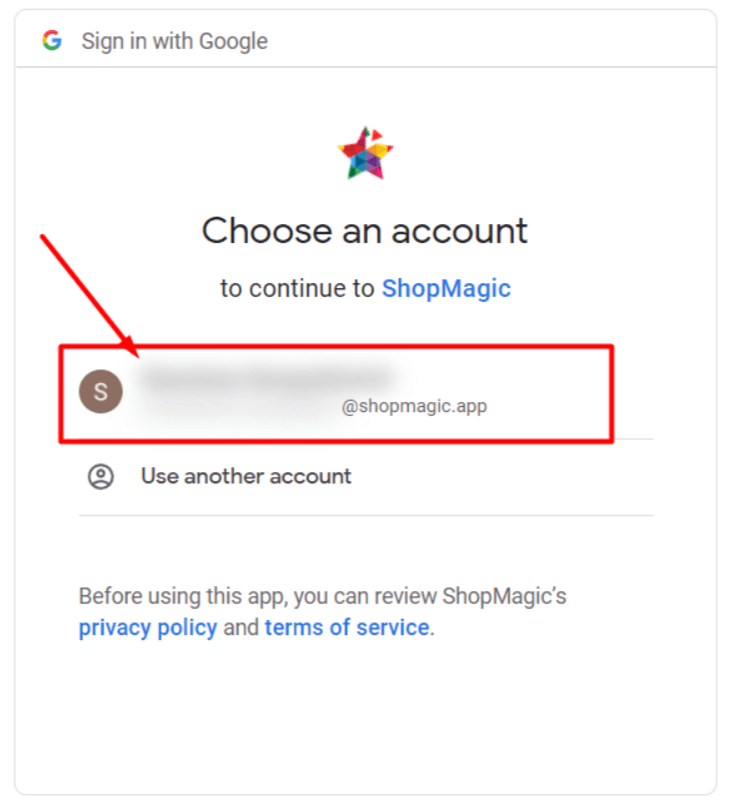
2. Choose the Google account
A new tab opens. Pick the account that owns the spreadsheet.
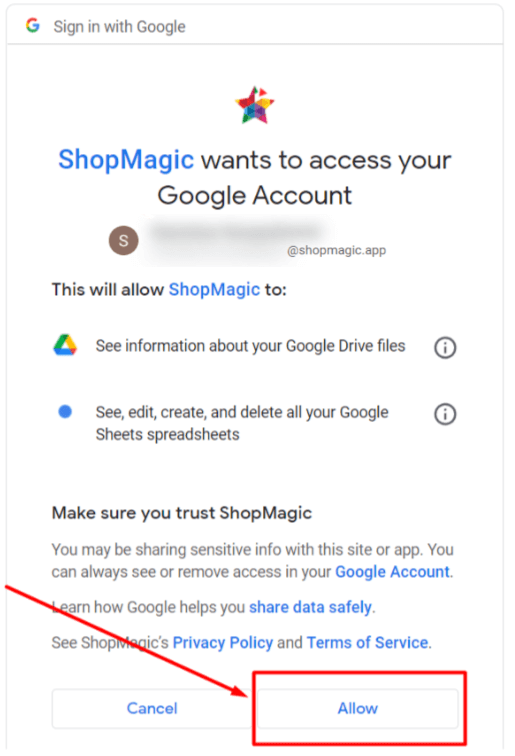
3. Allow access
Google asks for two permissions:
- See information about your Google Drive files. Spreadsheets live in Drive, and the integration needs to find yours.
- See, edit, create and delete your Google spreadsheets. This is the permission level Google defines for writing to a sheet; it is broader than what the integration does, which is add rows to the file you select.
4. Copy the token
The token appears. Copy it with the icon beside it.
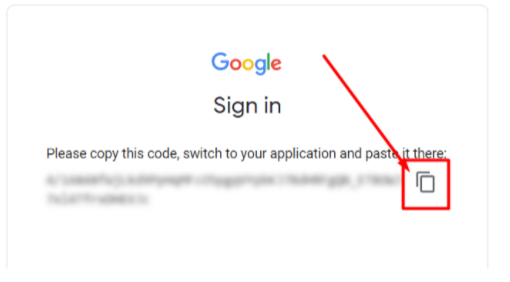
Treat this token as a credential. It authorises access to your spreadsheets, so it does not belong in a support ticket, a shared document or a screenshot.
5, 6 and 7. Paste and save
Return to the ShopMagic settings tab, paste the token into the field, and click Save changes.
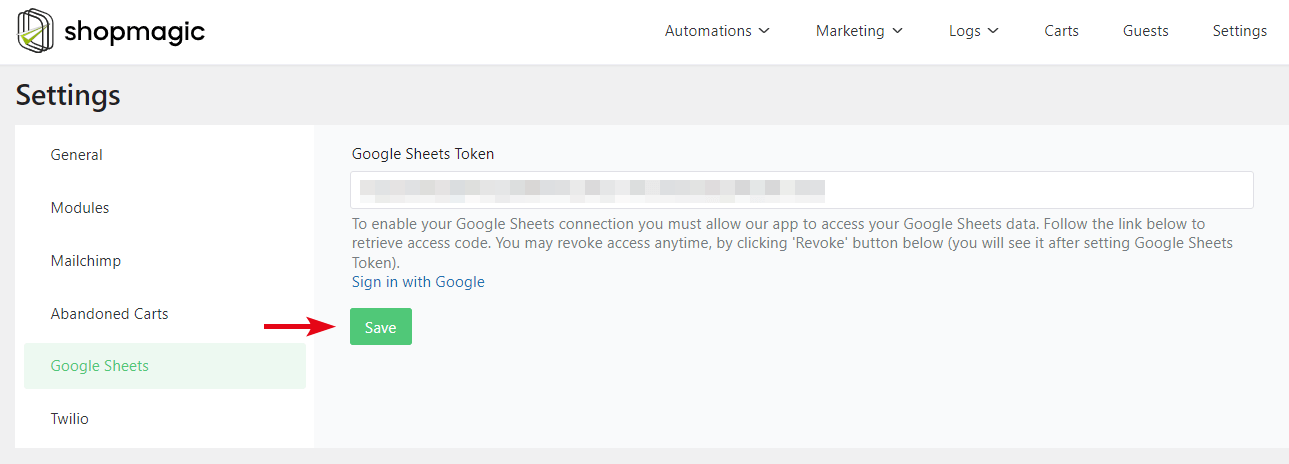
Set up the automation
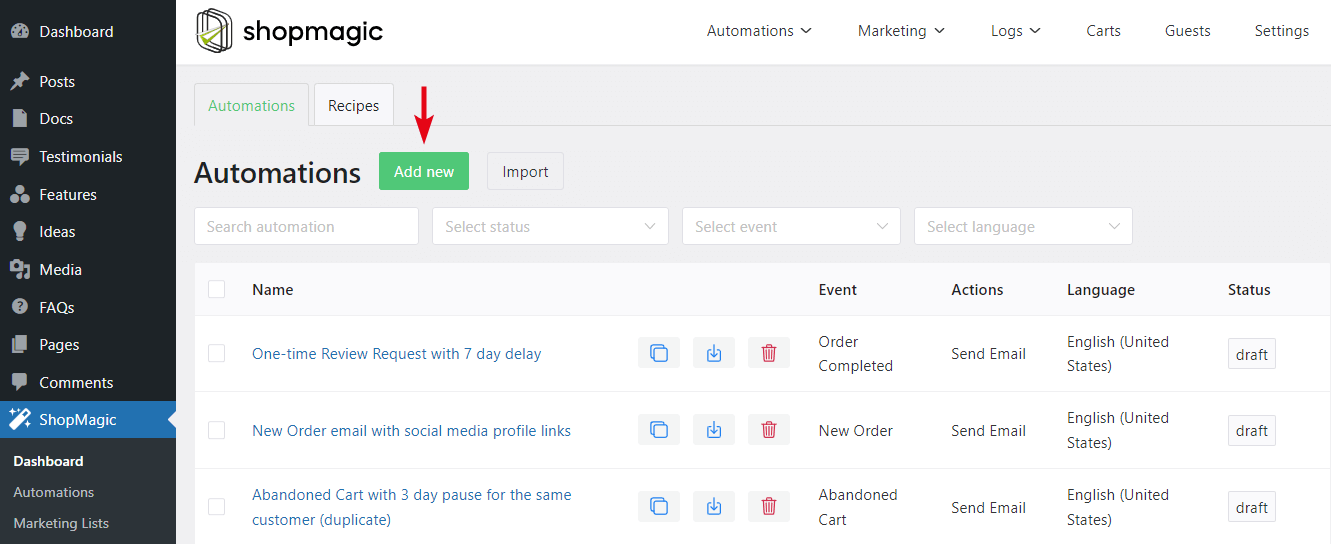
1. Add a new automation
Go to ShopMagic → Automations → Add New.
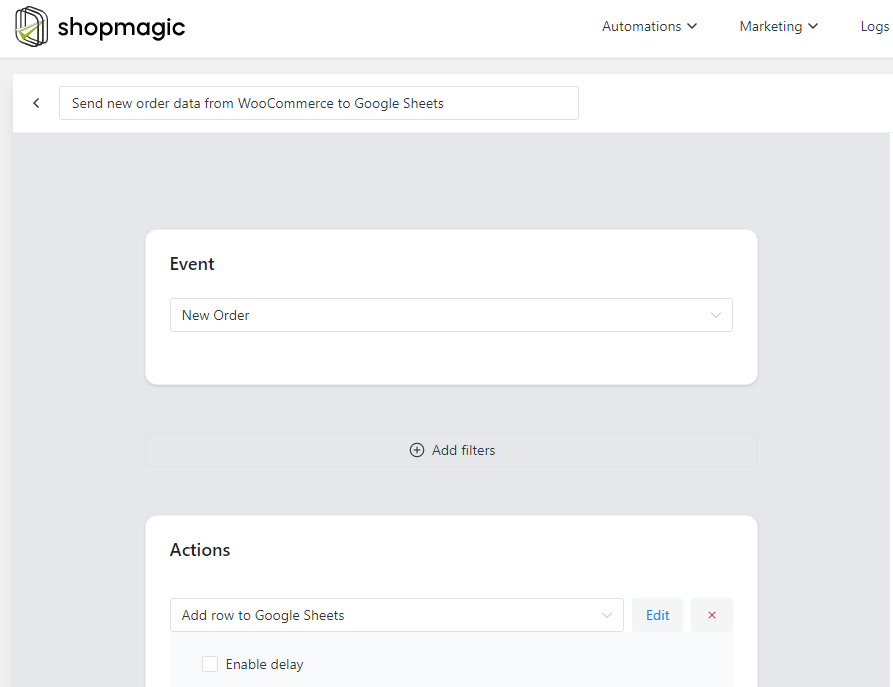
2. Map the columns
Choose the spreadsheet and tell each column which placeholder fills it.
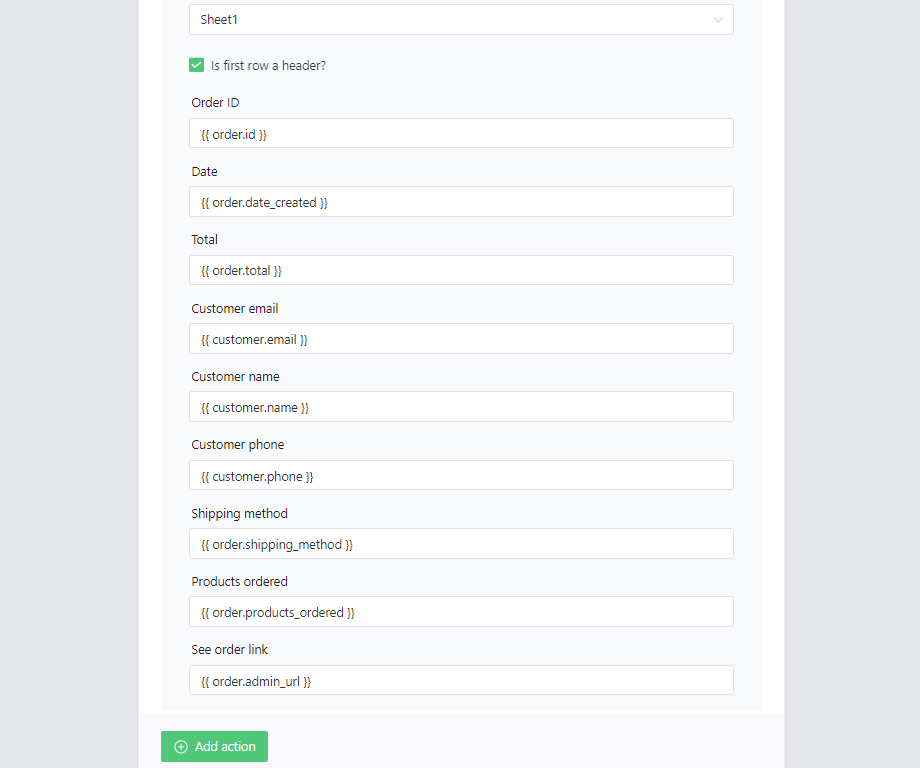
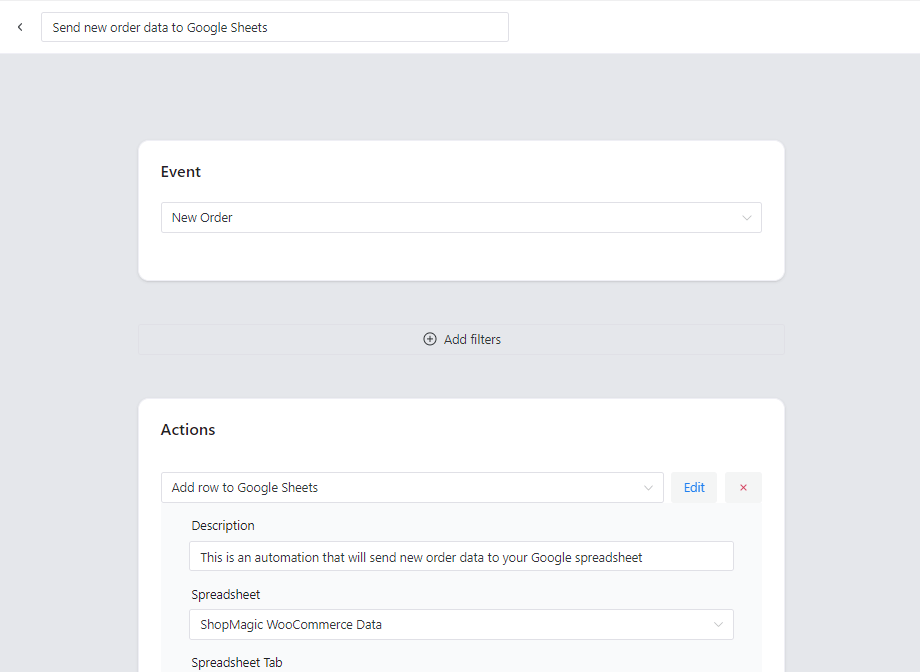
- Event: New order
- Action: Add row to Google Sheet
- Spreadsheet: pick it from the list of your sheets
- Spreadsheet tab: pick the tab
- Is first row a header?: tick it if row one holds your column names
- Order ID:
{{ order.id }} - Date:
{{ order.date_created }} - Total:
{{ order.total }} - Customer email:
{{ customer.email }} - Customer name:
{{ customer.name }} - Customer phone:
{{ customer.phone }} - City:
{{ order.shipping_city }} - Shipping method:
{{ order.shipping_method }} - Products ordered:
{{ order.products_ordered }} - See order link:
{{ order.admin_url }}
3. Publish, then place a test order
Publish the automation and check that a row actually appears.
Publishing is not proof. Place one test order and look at the sheet: the row should arrive with every placeholder resolved. An unresolved placeholder shows up as literal text in a cell, which is obvious in the spreadsheet and invisible in the settings screen.
From then on every new order adds a row by itself.
When the export stops working
Exports fail silently, which is the problem with them. Three causes cover almost everything.
The spreadsheet changed. Renaming the file, moving it to another Drive, or inserting a column after setup are the usual culprits. If you need a new column, add it at the end and update the mapping rather than inserting it in the middle.
Google access was withdrawn. Revoking the app in your Google account settings, or changing the password on the account that authorised it, invalidates the token. Generate a new one and paste it in.
The automation was switched off. Easy to do while testing something else, and nothing announces it.
Check the Logs tab first in all three cases: it records what ran and what failed, and it will tell you which of the three you are looking at. Worth glancing at once a month, since a spreadsheet that stopped filling in March looks exactly like a quiet March.
Summary
Getting WooCommerce order data into Google Sheets needs two free plugins, a Google account and a spreadsheet you have prepared in advance. The connection itself is one token: you request it from inside ShopMagic, approve the Google permissions, copy it, paste it back and save. The automation that follows is three decisions, namely the New Order event, the Add row to Google Sheet action, and a placeholder for each column you created.
Two things decide whether it keeps working. Lay out the columns before you start, because changing the sheet’s structure afterwards is the most common cause of an export that quietly stops. And test with a real order rather than trusting the Publish button, since unresolved placeholders only show themselves in the spreadsheet.
The reason to bother is that a sheet can be shared with a link. Anyone who needs the numbers, an accountant, a partner, whoever runs your ads, gets them without a WordPress account and without waiting for you to export a CSV.
See the ShopMagic for Google Sheets integration, or start with the free plugins:
ShopMagic
Customize emails, run email marketing, and connect WordPress and WooCommerce with Google Sheets.
Download for free or Go to WordPress.orgFrequently asked questions
Is the WooCommerce to Google Sheets integration free?
Yes. Both the core plugin and the Google Sheets add-on are free, and there is no limit on how many rows you send or per-operation pricing.
What data can I send to the spreadsheet?
Order data such as ID, date, total, customer details, shipping method and products, plus WordPress data including posts, comments, user details and form entries. Each column is filled by a placeholder.
Do I need the WooCommerce REST API for this?
No. The integration works through the plugin, which is why it suits the majority of stores that have never issued API keys.
What does the Google token do?
It authorises the plugin to write rows to spreadsheets in your Google account. Treat it as a credential and do not paste it into tickets or screenshots.
Why does Google ask for permission to delete my spreadsheets?
Because that is the scope Google defines for writing to a sheet. The integration adds rows to the file you select; the permission name is broader than what it does.
Can I add a column after setting the export up?
Yes, but add it at the end and update the mapping. Inserting a column into the middle of an existing sheet is the usual reason rows start landing in the wrong places.
Why did my spreadsheet stop filling?
Usually the sheet was renamed or moved, Google access was revoked, or the automation was switched off. The Logs tab shows which.
Can I export historical orders?
The automation runs on new orders from the moment you publish it. Existing orders are not sent retroactively.
