



Reviews are the cheapest conversion work a store can do, and most shops collect almost none of them. Not because customers are unwilling, but because the one email that asks is either never sent or sent three days before the parcel arrives.
When to send a review request
Seven to fourteen days after the product reaches the customer, not after the order is marked complete. That gap is where most review programmes quietly fail.
The reason is mechanical. Plenty of stores mark an order completed the moment it is handed to the courier, so an automation keyed to that status fires while the box is still in a van. The customer opens an email asking how they are getting on with something they have not seen, and the store has spent its single best opportunity on a message that cannot be answered.
Within the window itself, the right day depends on what you sell. Anything consumed quickly, like food or cosmetics, works at seven days. Anything with a learning curve, like tools or software, works better at fourteen or later, because the customer needs time to form the opinion you are asking for. Furniture and clothing sit in between, since the verdict arrives the moment it is unpacked.
What the email should ask for
One thing. A review request that also asks for a social share, a newsletter signup and a referral gets none of the four.
The request itself should name the product rather than the order. A customer who bought three items and receives an email about order 4471 has to go and look it up, and most will not. Naming the item, ideally with its image, removes the only friction left in the exchange.
It also helps to say how long it will take and to mean it. A link that opens straight onto the review field for that specific product converts several times better than one that lands on the product page and leaves the customer to scroll.
What to do with the reviews once they arrive
Answer the bad ones, publicly and quickly. A one-star review with a considered reply underneath does less damage than a page of unanswered five-star reviews does good, because it is the only evidence a reader has that somebody is paying attention.
Thanking people for good reviews is worth automating too, and it is one of the few places where a small discount code is uncontroversial, since the customer has already done you a favour and is not being paid in advance. We have a walkthrough of that pattern in our guide to the WooCommerce review email.
What is not worth doing is asking twice. One request is a request, a second is pressure, and the customers who ignore the first are rarely the ones whose opinion you wanted published.
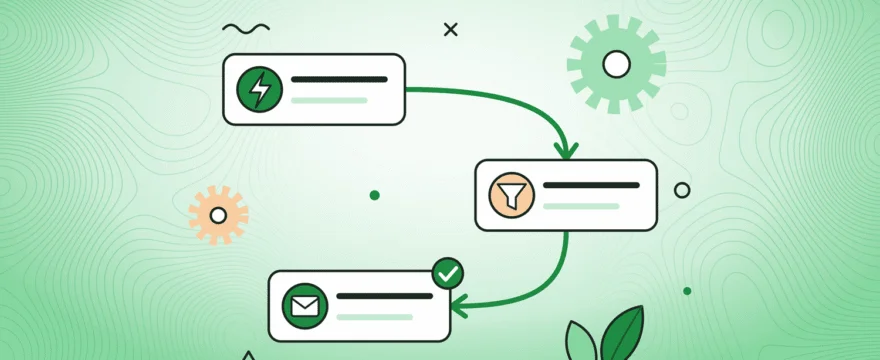
Naming the product and linking straight to its review field is what separates a request that works from one that gets ignored. Review Requests pulls the purchased product into the email and adds an event for a published review, so the thank-you can run on its own.
Summary
A review request belongs seven to fourteen days after the product reaches the customer rather than after the order is marked complete, because many stores complete an order at dispatch and the email then arrives while the parcel is still in transit. Inside that window the right day follows the category: about seven days for anything consumed quickly, fourteen or more for anything with a learning curve, and somewhere between the two for goods judged on unpacking.
The email should ask for exactly one thing, name the product rather than the order number, and link straight to the review field for that item instead of to the product page. A customer who has to find which of three purchases is meant will usually not bother. Afterwards, the bad reviews are the ones worth answering, publicly and quickly, since a considered reply under a one-star review is the only proof a reader has that somebody is listening. Thanking people for a review is worth automating, and it is one of the few safe places for a discount code, because the customer has already done the favour. Asking a second time is not worth doing at all.
Frequently asked questions
These three come up when a store starts collecting reviews deliberately.
Can you offer a discount in exchange for a review?
Offering it in advance, conditional on the review, is a problem in most jurisdictions and on most platforms. Sending a thank-you after one has been left is a different thing.
What if the customer bought several products?
Ask about one, usually the highest-value item. An email listing four products with four review links gets treated as a form rather than a question.
Should the request go to guest customers?
Yes, since the order carries an address regardless. Check that your review system accepts a review from somebody without an account before you send it.
